Cathy Ames
Cathy Ames, who later adopts the name Kate, is one of the most chilling figures in American literature, a character Steinbeck explicitly describes as a "monster" born without the potential for kindness or conscience. Her life is a systematic campaign of predation, using her doll-like beauty and a preternatural understanding of human weakness to manipulate, exploit, and destroy everyone who crosses her path. She is the engine of the novel's central tragedy, the living embodiment of the evil that the Trask family must confront, and the dark mirror against which the possibility of redemption and free will is measured.
Origins and the Nature of the Monster
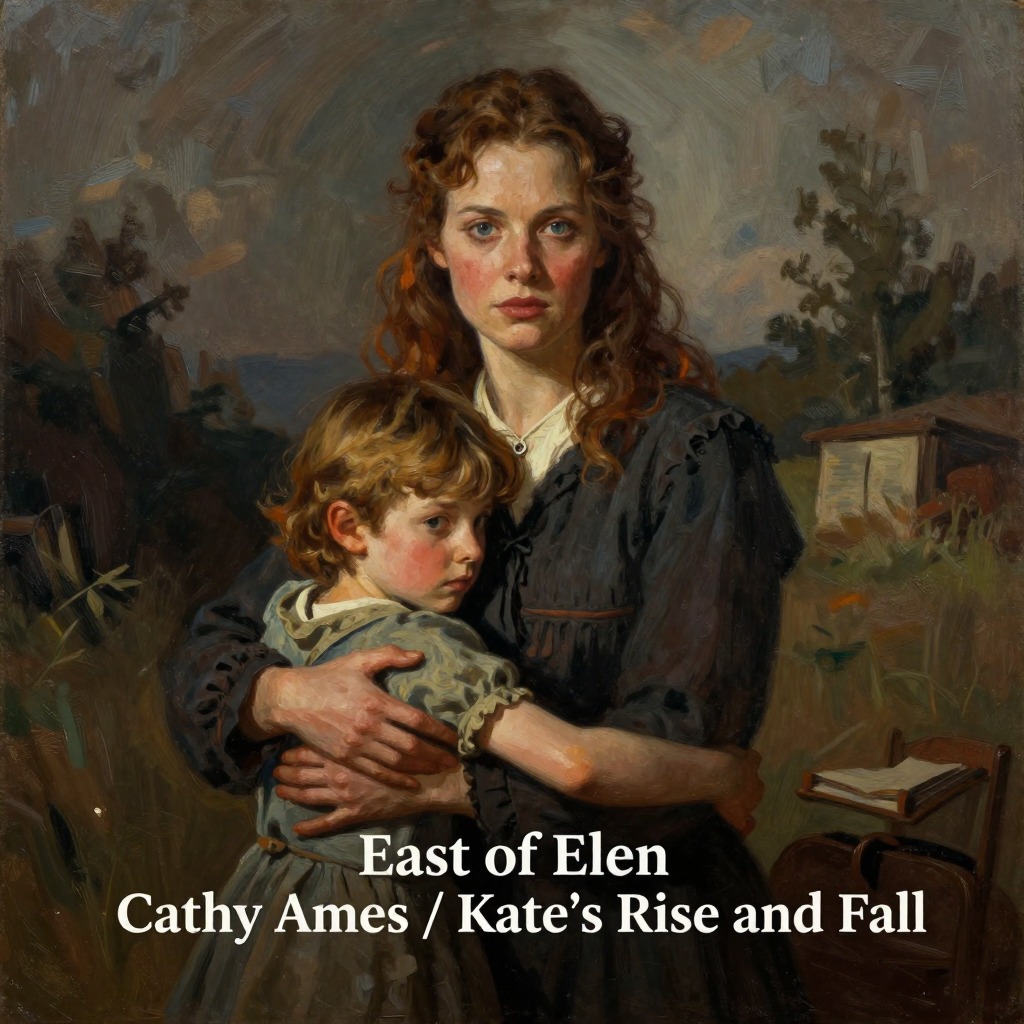
Steinbeck introduces Cathy as a "monster," a being born with a "malformed soul" akin to a physical deformity. From her earliest years in a Massachusetts town, she is set apart. She possesses a face of "innocence"—golden hair, wide-set hazel eyes, a rosebud mouth—that belies a complete absence of empathy. She is a consummate liar, not for daydreaming but for "profit or escape," and she learns early that "sexuality with all its attendant yearnings and pains, jealousies and taboos, is the most disturbing impulse humans have." She coldly experiments with this power, using it as a "weapon and a threat" to gain control over others. Her first known act of destruction is the manipulation of two local boys, whom she leads into a compromising situation and then allows to be brutally punished and sent to a house of correction while she plays the victim. This pattern of using her perceived innocence to destroy others is established as her core method.
A Trail of Destruction: From Massachusetts to Salinas
Cathy's path is littered with the wreckage of lives. She drives her Latin teacher, James Grew, to suicide after a clandestine affair, then plants a rumor to cover her tracks. She later sets fire to her family home, murdering her parents and stealing money to fake her own death. She then enters the world of prostitution, first as a worker for the whoremaster Mr. Edwards, whom she manipulates into a destructive obsession. When he discovers her past and tries to kill her, she nearly dies but is found and nursed back to health by Adam Trask. Adam, seeing only her beauty and vulnerability, falls deeply in love and marries her. She uses this marriage as a temporary refuge, but her contempt for his kindness is absolute. After giving birth to twin sons, Caleb and Aron, she attempts to abort herself and, failing that, abandons them. When Adam tries to stop her from leaving, she shoots him in the shoulder with a .44 Colt revolver and walks out without a backward glance, leaving him for dead and her newborn sons to be raised by others.
The Reign of Kate: Power, Perversion, and Paranoia
In Salinas, Cathy re-creates herself as Kate, the madam of a brothel that becomes the most vicious and depraved in the region. She systematically takes over the business from the kindly madam Faye, poisoning her slowly and inheriting her fortune. Kate's house is not merely a place of prostitution but a theater of cruelty, catering to the "crippled and crooked" and the "ugly, the distorted and slimy" desires of men. She amasses a fortune and a collection of photographs used for blackmail, wielding power over some of the most prominent men in the county. Her life is one of cold calculation and control, yet it is also a life of profound paranoia. The fear of being discovered for Faye's murder and the creeping pain of arthritis drive her into a self-imposed isolation in a windowless gray room, a physical manifestation of her inner emptiness. Her only moments of vulnerability come when she confronts her sons: she feels a strange kinship with the dark, calculating Cal, but is deeply unsettled by the angelic Aron, whose purity she instinctively hates and whose resemblance to her own former innocence she finds threatening.
The Final Act and Thematic Significance
Kate's end is as calculated as her life. After Cal brings Aron to her brothel, shattering his brother's idealized world, Kate sees the horror and despair in her son's face. This confrontation, combined with her fear of exposure, leads her to a final act of control. She writes a will leaving her fortune to Aron, then retreats to her gray room, swallows a capsule of morphine, and dies, effectively erasing herself. Her final thought is of Alice in Wonderland, a childhood fantasy of shrinking away from a hostile world into nothingness. Cathy/Kate is the novel's ultimate test of its central theme: the power of choice, encapsulated in the Hebrew word timshel—"Thou mayest." She represents the deterministic pull of evil, the belief that one is fated by blood or circumstance. Her life is a testament to the reality of evil, but her death, and the legacy of pain she leaves, forces the surviving characters—especially Cal—to confront the possibility that they are not bound by her nature, that they have the power to choose a different path. She is the darkness against which the light of free will must be defined.